
"Death! Nothing But Death!"
Remembering a forgotten soldier on Memorial Day weekend

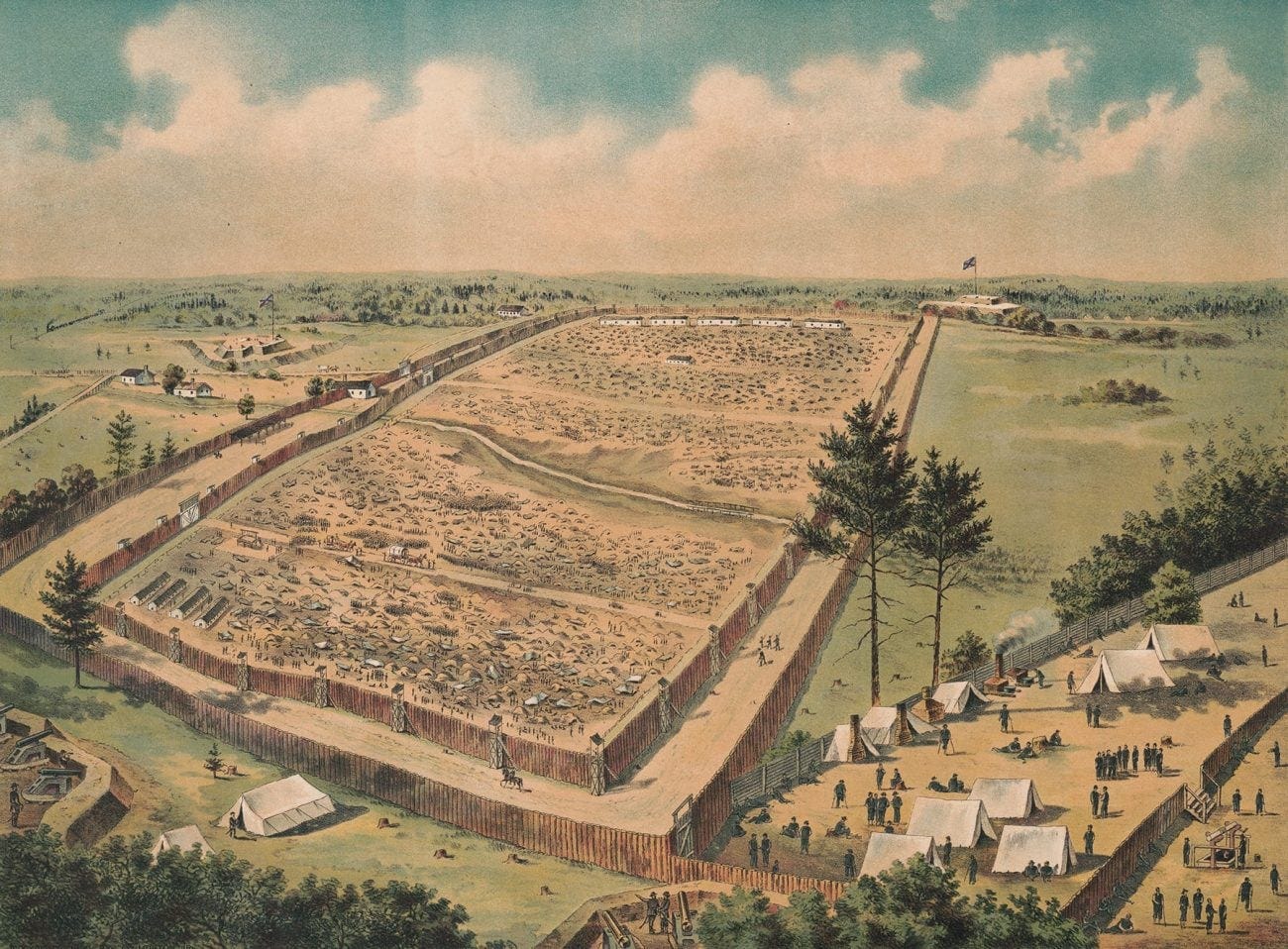
On May 4, 1864, the 7th Pennsylvania Reserve regiment found itself surrounded by Confederates in a tangle of woods in Virginia known as The Wilderness. While the battle would continue to rage and the American Civil War would go on for nearly another year, the men of the 7th Reserves would soon be fighting a war of a different sort—the war for survival.
A grueling march of 17 days would take them from Virgina to Georgia, where they would be held as inmates in the infamous Andersonville Prison, an open air stockade where thousands of men would be jammed in together with little food or water, and little hope of making it out alive. Private Samuel Elliot of Company A of the 7th, a resident of Carlisle, PA, wrote his first impression of the prison that had at that time only been operating for about three months:
The camp contains about fifteen thousand men, most of whom have been prisoners from eight to ten months [but kept in other prisoners before this one], and were once strong, able bodied men, but are now nothing more than walking skeletons, covered with filth and vermin, and can hardly be recognized as white men. The horrible sights are almost enough to make us give up in dispair—the ground is covered with filth, and vermin can be seen crawling in the sand. In the centre of the camp is a stream of dirty water so warm and greasy we can scarcely drink it. The sights I saw on this, my first day in Andersonville, so filled me with horror that I can give but a poor idea of this prison den.
Dozens of men would die of disease, starvation, and exposure in the seven months that the members of the 7th were held in captivity at Andersonville and at Florence, a prison harboring even worse conditions. Elliot would write, “It is terrible to see how our regiment is thinning out; every day brings the sad news of the death of one or more of our comrades. Death! nothing but death!”
Still, there were members of the regiment who somehow survived the ordeal, at least physically. Many came home broken by the deprivations they had experienced, never to be the same again. Private Jackson Martin had been a farmer from the Dillsburg area before the war, and by all accounts he was a healthy, hard-working lad when he joined the regiment in February of 1864. He joined a veteran unit that had been engaged in many of the Army of the Potomac’s battles since 1861, but this new soldier would only experience one battle before enduring the hell of imprisonment.
We don’t have a record of how Martin survived Andersonville. Being relatively healthy in comparison to his veteran comrades who had been beaten down by long marches and the horrors of combat likely helped his cause. But Andersonville seemed to take everything from Martin—his health, his strength, and his ability to overcome.
Martin returned home like many veterans of war, carrying the mental and physical scars. Weakened by starvation and wracked with disease, he never really recovered. He would live until 1928, but spent most of his remaining years suffering in silence. He never claimed a military pension, and died in the poor house without a penny to his name. He was buried in an unmarked grave at Fileys Christ Lutheran Church Cemetery in Dillsburg, with no headstone to remind future generations of his life or his service.
You could say that the real Jackson Martin died at Andersonville, just like countless other veterans of all of America’s wars who gave their lives, their health, and their futures in service to their country. They have seen death, nothing but death. On Memorial Day we remember those who died in combat, but it’s important that we also remember those whose lives were forever altered by their service. Their silent stares and hidden scars may have received no public recognition, but their sacrifice is worthy of all the honor we can give.
Occasionally, we have the chance to render that honor and this Memorial Day weekend is one of those times. My friends in the Pennsylvania Reserve Volunteer Corps Historical Society have taken on the mission of honoring these soldiers and keeping their memory alive. They discovered Private Martin’s story and launched an effort to honor him through the placement of a stone to mark his final resting place. They secured a government-issued headstone through the U.S. Department of Veteran’s Affairs and have a local funeral home and memorial company donating their services for its installation.
All that is needed now is the ceremony—the funeral setting that Private Jackson likely never received. On Saturday, May 23, at 11:00am, I will have the honor of presiding as Master of Ceremonies for this special event honoring Private Jackson and marking Memorial Day. The event is sponsored by my friends at the Pennsylvania Reserve Volunteer Corps Historical Society. I hope that those of you who live in the area would consider joining us for this special event at Fileys Christ Lutheran Church Cemetery (15 S. Fileys Rd., Dillsburg, PA 17019). Local, state, and national legislators will be joining us, as well as local musicians and a color guard from the 28th Infantry Division.
On a weekend where we normally gear up for being outside, enjoying the weather, having picnics, and taking an extra day off, I encourage you, wherever you are, to take some time for Memorial Day events near you. Now as ever, we must be reminded that freedom isn’t free. We remember those who have given their lives in so many ways, even as we pray for the day when death is defeated, when peace is the standard in God’s eternal Kingdom, and when all soldiers will come home forever.
For more information about the Gravesite Dedication for Private Jackson Martin, go to this link.
Additional Sources:
Orr, Timothy. “Death! Nothing But Death! The Capture of the 7th Pennsylvania Reserve Infantry, Part 1.” Tales from the Army of the Potomac website, July 14, 2015.
This Week’s Podcast
What did the early Church actually look like after Pentecost? In this episode of the Aldersgate Experience Podcast, we dive deep into Acts 2 and explore how the Holy Spirit formed a radically different kind of community—one devoted to Scripture, prayer, fellowship, generosity, and the breaking of bread. We discuss why the modern church often drifts toward entertainment instead of transformation, how the early Christians understood worship, and why biblical community is essential in an age of isolation. From the Wesleyan Quadrilateral to the meaning of koinonia, this conversation unpacks how the Church becomes the people of God through Word, Table, and Spirit-filled living. If you’re hungry for deeper discipleship and authentic Christianity, this episode is for you.
This Week in Worship (3.17.26)

In Acts 3, Peter and John perform a miraculous healing "in the name of Jesus." While we might think that miracles and healings are a good thing, the fact that it's done under the authority of Jesus is a problem for the Temple officials. The authority of Jesus' name still causes problems today, causing many to want to silence the voices of those who proclaim and live the reality that he is Lord. Peter and John proclaimed Jesus as the "cornerstone"--a stone rejected that had now become the foundation of something new that God had planned all along. The power and presence of God was no longer to be found in the Temple, but in the person and name of Jesus and in the power of his Spirit dwelling with his people. Join us this Sunday as we look at this important text and explore the implications of what it means to live and work under the name of Jesus!