
Everything is Never Enough
Why Ecclesiastes may just be the perfect book for our times.

If the book we’re reading doesn’t wake us up with a blow on the head, what are we reading it for?… But we need books that affect us like a disaster that grieves us deeply… A book must be the axe for the frozen sea inside us. - Franz Kafka
The Book of Ecclesiastes is one of those pieces of biblical literature that we tend to skip over. Sure, there’s that famous poetic set of verses in chapter 3 that was made famous in the song “Turn, Turn, Turn” by the Byrds in 1965: “To everything…there is a season, and a time for every purpose under heaven.” But then there’s that depressing opening: “Vanity of vanities, says the Teacher, vanity of vanities! All is vanity! Other translations replace “vanity” with “meaningless,” but the point is the same. We’re just “chasing after wind.”
It might seem that Ecclesiastes doesn’t have much application to our twenty-first century lives, given our proclivity toward what German sociologist Hartmut Rosa calls “social acceleration,” or the accelerated tempo of life in the areas of technology, social change, and pace of life. We’re too busy trying to catch up to life to actually ponder its meaning or its absurdity. Perhaps we’re afraid we’ll discover that the Teacher (Qohelet in Hebrew) was actually right—that we’re actually going nowhere, just at a faster pace.
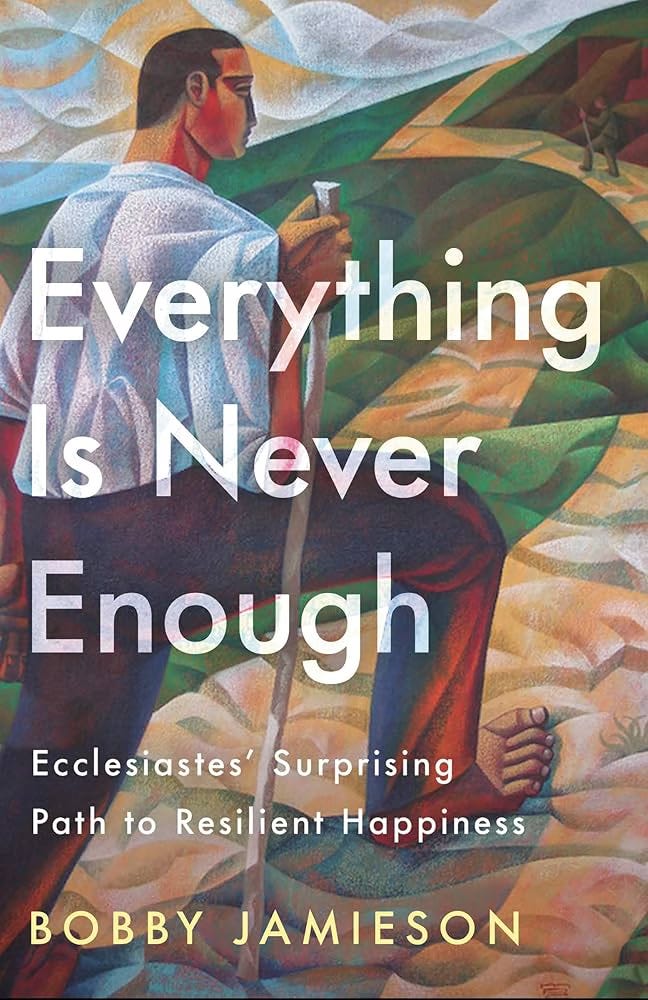
But to boil down Ecclesiastes to a melancholy treatise on the meaninglessness of life is to sell it short. Bobby Jamieson has written a book that is one of those axes breaking through the ice, revealing that Ecclesiastes actually provides us not only with the reality but also the remedy for living life in a world that is uncontrollable. Everything is Never Enough: Ecclesiastes’ Surprising Path to Resilient Happiness (Waterbrook, 2025) is a wonderful primer on this helpful little book of the Bible that is packed with ice-breaking wisdom.
That word “hevel” in Hebrew, translated “vanity” or “meaningless,” is actually closer to what Jamieson calls “absurd.” Life is “absurd,” he says paraphrasing Qohelet, because life is uncontrollable—a shocking revelation in a world where the rapid acceleration of change gives the illusion of more control. Hartmut Rosa (whom Jamieson quotes liberally in the book), calls the modern way of acting and being in the world the “triple-A approach,” attempting to make more and more of the world’s qualities “available, accessible, and attainable.” But this is the real problem—everything is never enough.
Qohelet (who may or may not have been King Solomon) writes that he had, indeed, gotten everything a person could reasonably hope for in this life—riches, relationships, wisdom, power—but it wasn’t enough. In the end, you can’t take it with you. Someone else will get all that you strived after, and you will be forgotten in just a couple of generations. “Striving after wind,” in the words of Ecclesiastes, is trying to control the uncontrollable. It’s a reminder that in life, “You’re not the captain, you’re not even in the boat. In the end, you’re a fish in the ship’s net.”
Depressing? Not really. It’s the truth and the sooner we grasp it, says Ecclesiastes, the sooner we can pursue real happiness. We don’t find that ultimate happiness in work (“You can love your work, but it doesn’t love you back,” says Jamieson). Our appetites for things like wealth, sex, and power are like “an industrial garbage disposal that’s always running. No matter what you throw into it, after absurdly quick digestion, its gullet will gape, empty as ever.” Our hearts are designed with a hole that lets in the infinite, which is why all the finite goods that we strive after will never satisfy.
So what is real happiness? It’s an ache for the world God intended. It’s seeking to fill that empty hole with more of God. “Happiness comes not from trying to make the world satisfy all your desires,” says Jamieson, “but from realizing that it never will. ..Happiness begins to glimpse new dimensions when you discover that everything is never enough.”
This book, along with reading more closely through Ecclesiastes, has been dominating my thoughts over the last few weeks. To borrow from Kafka, it was a “blow to the head” and a “disaster” that awakened a desire to explore some of the angst I’ve been feeling with my own aging process. Perhaps it’s because I’m at the stage of life where I’ve finally found Qohelet’s wisdom to be true in its stark picture of reality. Pondering one’s mortality creeping closer puts life into perspective. When you’re young, you’re always focused on the future, fueled by ambition. When you’re in middle age, you focus on maintaining what you have and making sure your family has enough. You focus on your work and your productivity. But there comes a point at which, if you’re blessed to make it that far, that you’ve been there, done that and the question seeps in: What’s it all been about?
Ecclesiastes answers: “The end of the matter… Fear God and keep his commandments; for that is the whole duty of everyone. For will bring every deed into judgment, including every secret thing, whether good or evil” (Ecclesiastes 11:13-14). Or, as the early church father John Chrysostom put it similarly, “If you knew how soon people will forget you after you die, you would do nothing in your life but please God.”
That’s a view of life that’s all about the present, recognizing that it’s all that we have. And rather than see the present as a temporary stop between pining for the past or looking to the future, Ecclesiastes invites us to savor the present moment as a gift. I like how Jamieson reframes it—that we need to be fully present so that we can open the present’s presents!
I loved this book and have been recommending it to others, particularly to folks who are little later in life and pondering what it’s about. But I also think it’s the perfect book for young people who are beginning to navigate the world and chasing after the wind. The sooner we understand that happiness isn’t about getting everything, but rather about receiving the gift of God and responding with our lives, the better we can live our lives with purpose and contentment, no matter the circumstances.
Everything is never enough. But God is enough, and so are we as his people. That’s a good lesson for any age.
Note: For an interview with the author, check out this episode of The Art of Manliness podcast, which is where I first heard about the book.
This Week’s Podcast
Are you walking in spiritual darkness without realizing it? If you’ve felt spiritually disoriented, this episode will help you refocus your gaze on Christ and walk in the light.
This Week in Worship (3.15.26)
When disaster strikes, theological questions are quick to arise. Why do bad things happen to good people? Theologians call it the "problem of evil" or "theodicy" and it affects us all at some point. Jesus was confronted with a similar question by some people in the crowd, and his answer was less about the "why" and more about how to be prepared for sudden disaster and death. Taking up a theme to which we were introduced by John the Baptist, Jesus urges us to be ready by living in repentance, bearing "fruit" for God's Kingdom. Join us on Sunday at Aldersgate Church as we look at this important teaching of Jesus as we follow him on the road to the cross.