
Remember Me
A sermon for Good Friday

Note: This is the manuscript of the message I’ll be preaching at today’s Good Friday services at Aldersgate (Noon and 7:00pm).
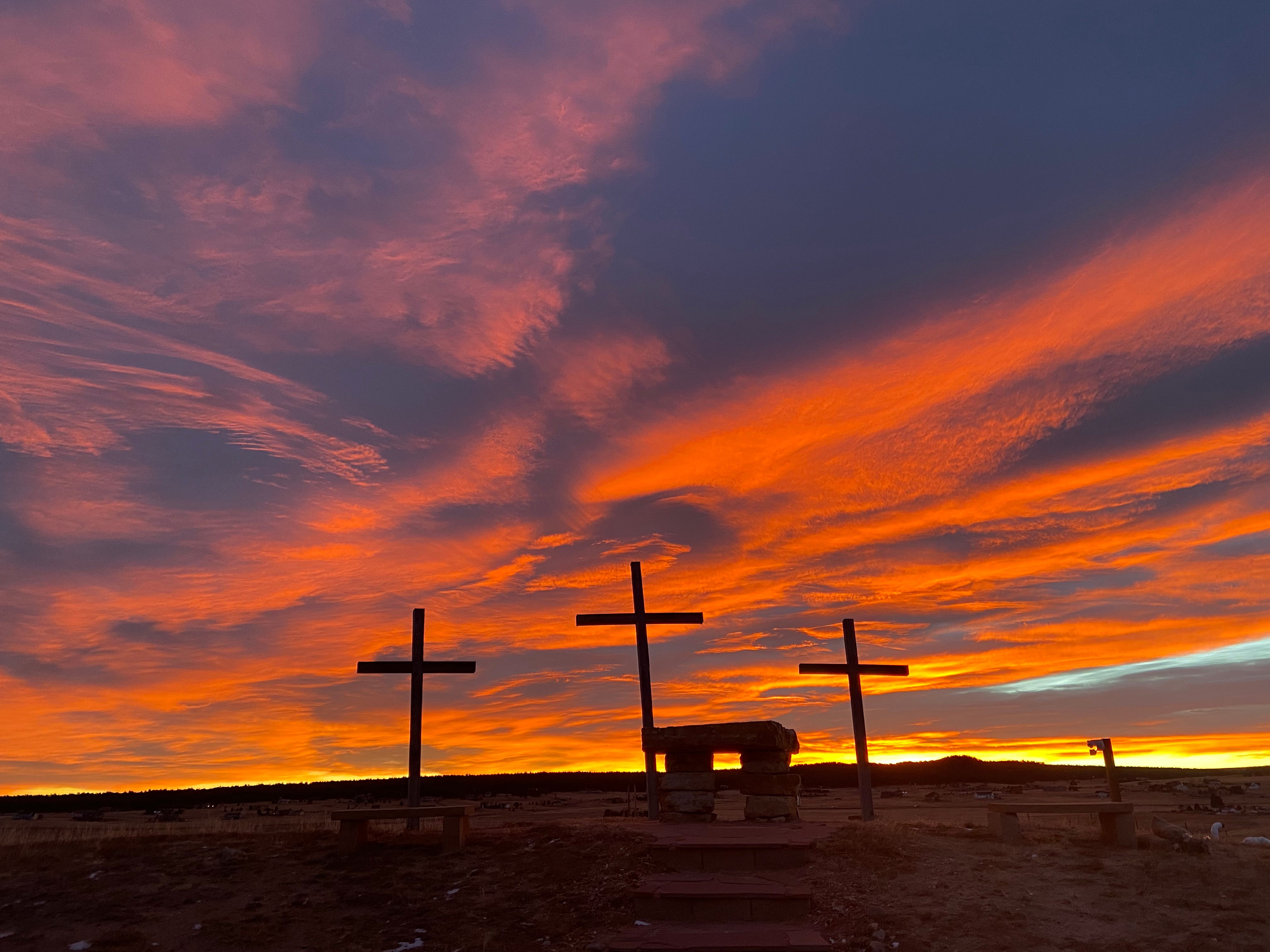
One of the features I loved about my last church in Colorado was our outdoor worship space. On a small hill above our parking lot, some of the men had put up three life-sized wooden crosses as a way for people passing by on the highway to recognize the church. I liked those crosses so much that I wanted to develop the site a bit more. We had Boy Scouts earning their eagle badges put in a platform of paving stones around the crosses and steps leading up to them. The art committee added a stone altar table so that we could do outdoor services there, and some benches for people to sit and reflect. It was a beautiful setting, especially when the sunrise came up behind those crosses. I treasure those incredible pictures.
Little did we know how much time we’d all be spending on that hill with the crosses, however. During the COVID pandemic, we transitioned our worship outdoors for “drive-in” worship services. We ran power and fiber optic internet cable out to the crosses so that we could broadcast services over FM radio to our people tailgating in the parking lot on Sunday mornings and livestream them to the rest of the world. We worshipped outdoors for 15 straight weeks that summer and fall, and even did Christmas Eve services out there in 22 degree weather. I got to know those crosses well and sometimes just spent time out there by myself to pray during the uncertainty of that time.
Not everyone liked the crosses, however. We had neighbors who didn’t appreciate the extra traffic and hubbub on Sunday mornings. One neighbor especially hated the church, constantly complaining and sometimes even showing up drunk to berate us during meetings. One morning when I went to work, I looked up on the hill found that the stone altar we had built had been smashed to pieces with a sledgehammer. The proclamation of the cross had infuriated someone, perhaps it was that neighbor or another who wanted the noise to stop. We never found out who did it or why.
I was shocked by the violence of that act, the violation of sacred space, but I wasn’t surprised. The cross has always evoked strong emotions in people—some see it as beauty and hope, others as a threat to their preferred way of life. It was that way from the beginning. In fact, the three crosses on the hill represent that stark contrast in and of themselves. One represents mockery and hate, skepticism and self-interest. The other represents hope and faith, salvation and life. In the middle, the cross of Christ stands as the dividing line, the central question of all of human life from that day of his crucifixion to this day: What will you do with Jesus?
Luke has been hinting at this question all along our long walk through his Gospel. We’ve known for quite some time that Jesus has been on the way to the cross. Along the way, people have asked the question, “Who is this?” Pharisees and self-righteous skeptics see him as a fraud; one who upsets their traditions and hangs out with the wrong crowd. The sick and the sinners see him as a healer, someone who sees them and wants to be with them. Satan himself had questioned Jesus’ identity, tempting him to take a middle way that would use his power for popularity; to be the kind of Messiah that people expected and could get behind, a Messiah who could be easily manipulated—”If you are the Son of God…”
But Jesus knew there was no middle way. One could either reject him or repent and follow him. And now, here on another hill with three crosses, that choice comes into clear focus. What will you do with the man on the middle cross?
Two convicted criminals are crucified with Jesus. Their crimes are unspecified, but the language in the Greek suggests that they are more than common thieves. They are “bandits,” violent men who, possibly like Barabbas, had participated in armed insurrection against Rome. These men had blood on their hands, their crimes capital in nature. In between them is Jesus, innocent of any crime, and yet, as Isaiah foretold, he would be “numbered with the transgressors” (Isaiah 53:12). In the voices of those crucified on either side of Jesus, we hear the only two responses one can make to Jesus.
On one side is the voice of rejection—
One of the criminals who hung there hurled insults at him: “Aren’t you the Messiah? Save yourself and us!”(Luke 23:39)
What at first sounds like faith is actually a concern for self-preservation. It’s the same voice we have heard from those who wanted Jesus to give them signs, to offer them proof, to save them on their own terms. It’s the voice that sounds a lot like Satan—Aren’t you the Son of God? If you are, give the people what they want; give me what I want. Fix this problem, remove my pain, get me down from this cross and maybe then I’ll follow you. Echoing the taunts of the religious leaders and the soldiers, the criminal cries with mocking derision, “Save yourself and us!”
They don’t believe he can do it. In their self-interest, they do not see what is he doing, nor do they see their own complicity in putting him on that cross. They are blinded to their own sin, wanting a quick fix.
They reject a Jesus who doesn’t conform to their expectations. They want a strong man, a superhero, not a bleeding and dying would-be king. And so, they break him down, take a sledgehammer to the altar of worship, and hope to never hear about him again.
But Jesus knew that he could not save us by saving himself. He knew that he could break the power of sin and evil only in this way. He had spent his ministry with broken people, and now found himself in the midst of them again—becoming broken for them.
Somehow, the other criminal, saw the truth. We’ve seen in Luke’s Gospel how it was the broken who seemed to understand him—not the religious experts, not the crowds, not even those closest to him. And so it is in the voice of the other dying criminal that we hear the other response to Jesus; we hear the voice of repentance.
This man on the other side of Jesus is in the same pain as the mocking criminal, in the same moment of suffering, looking at the same Jesus. But unlike his fellow condemned prisoner, this man looks at the suffering Christ and sees something different; something that causes him to look deeper at himself; something that causes him to see the man on the middle cross as a crucified king. In Jesus, he sees—hope.
“Do you not fear God?” he gasps at his comrade. “We are punished justly, for we are getting what our deeds deserve. But this man has done nothing wrong.”
In that short statement, the dying thief confesses three things:
First, he fears God—not in terror but in deep awareness. Awareness of God’s justice, his grace; an awareness of his holiness. A recognition that he is accountable to God.
Second, he recognizes his own sin. He knew that he was getting what he deserved. He was a sinner, perhaps of the worst sort. He makes no excuses. He doesn’t shift blame. He confesses.
And third, he recognizes Jesus’ innocence—that Jesus had done nothing wrong. That the man on the middle cross was dying in the place of another criminal, Barabbas, likely the leader of the criminal, insurrectionist band. It was unjust, a criminal act in itself. And yet, even in the midst of that horror, the dying criminal looked at Jesus and saw that the charge laid above his head, “King of the Jews,” might actually be true. Indeed, the man on the middle cross might just be truth himself.
And so, he directs his dying words toward him. “Jesus,” he calls him by name, “remember me when you come into your kingdom.” A simple request. An act of faith. No bluster of self-righteousness like the rich ruler. No bold posturing like the disciples. No demand for a sign like the crowds—but a parting word, a plea, a hope, a broken man crying out with his last breath to be made whole.
One of the things I love about Luke is that he gives us the gospel in many different forms—from Jesus’ preaching in Nazareth, to a parable about lost sons and a scandalously graceful father. Jesus has always been accused of welcoming sinners. Now he is among them, and this scene on the cross is an acted scene of the gospel in action. Jesus had said it would take just a small mustard seed of faith to enter the kingdom, and here it is—a last request, an inkling of faith, a hope to be remembered. “Remember me.”
And Jesus says, “Truly I tell you, today, you will be with me in Paradise.”
He doesn’t say, “It’s too late.” He didn’t say, “You should have done better” He won’t say, “Let’s wait and see.”
Instead, Jesus responds to the simple cry of faith with assurance—”Truly I tell you. With immediacy—”Today.” With a personal invitation, “you will be with me.” And with a promise, “in Paradise.”
This is the heart of the gospel—good news for dying sinners…and we’re all dying sinners. And we have a choice to make about Jesus. John Wesley points out that this was the criminal’s first and only opportunity of knowing Christ, and he didn’t waste it. He gave the man on the middle cross his last ounce of faith, and the king who welcomed sinners, and died among and for them, welcomed him to his kingdom.
You may have seen a clip of Alistair Begg’s sermon on this story—I love to share it. He imagines the scene of this man showing up at the gates of Paradise and an angel questioning him. How did you get here? Do you understand the doctrine of justification by faith? Did you do a lot of good works? Did you get baptized and serve on church committees?
And the man said, No…I don’t know anything about all that. I’m only here because the man on the middle cross said I can come. It’s because of him…it’s because of Jesus.
Three crosses stand on a hill. One represents rejection. The other repentance and faith. The middle cross is the dividing line. It’s a scene that forces a choice—what will you do with Jesus?
After the stone altar on the hill outside the church was smashed, a couple of our church members had an idea—they didn’t let the moment go to waste. They decided that the broken pieces mattered—that somehow they were in themselves a sign of the truth of the gospel. What the world wanted to reject, to smash, to destroy, to crucify, God meant as the healing of the world. What was broken can be made whole—that the broken pieces of our lives, the sharp edges of a sinful world, are not a surprise to Jesus, who spent his time with broken people.
And so, these faithful people gathered up the broken pieces of the altar and made them into crosses. I have one of them, a treasured gift—a reminder to me that it is the broken body and shed blood of Jesus that makes us whole. It’s a sign that the world can never destroy the truth—that our crucified savior is the king.
Whatever brokenness you are carrying today, whatever sins, whatever hurts—I invite you today to bring all those pieces to the cross. I invite you to consider this as a moment to draw close to Jesus, to hear his word of forgiveness and hope. It’s not too late. You can be saved, today. You can know him today. You can be with him today. You can know the assurance that one day you, too, will be with him in Paradise, a place of rest and refreshment, awaiting the great day of resurrection when all that is broken will be made new.
Jesus, remember me, when you come into your kingdom. May that be our cry to the man on the middle cross. Amen.
Thank you Bob for always making me a better person and spiritually uplifting me. Your words captivate me with history and truth and relevance.
Happy Easter
"The man on the middle cross said I could come"...🤗. As soon as you wrote about the 3 crosses on a hill placed above the parking lot I had to smile because just this week I was wondering if anyplace would have this display today. I once saw it around here quite a few years ago with men on it and I just loved seeing it. Maybe Aldergate would do that some Good Friday .
I enjoyed the post and video.
Happy Good Friday and see you at the church.