
Treat 'Em Rough
The importance of doing your best when you'd rather be doing something else

In the summer of 1985, I was an intern with the interpretive staff at Gettysburg National Military Park. Actually, I believe I was the first college intern ever in that department; a gig that came about because I sent an impassioned letter to the Chief Interpretive Ranger, John Andrews, begging for a chance to spend the summer walking the field for college credit. He responded by putting together an unpaid internship that had me doing battle walks with visitors a couple of times a day, but also exposing me to other parts of the historical and cultural landscape with different park departments.
One of those departments was the Eisenhower Farm, the retreat and retirement home that the 34th President and his wife Mamie purchased in 1950 and that became a national historic site. I was to spend a week out there shadowing the interpretive rangers and learning more about Eisenhower and managing the site. Truth be told, I did not look forward to it. I was a bonafide Civil War nut at that time, with little interest in anything that would take me away from talking about Pickett’s Charge or Little Round Top. The Eisenhower Farm represented to me a week exiled from the real battlefield, away from talking about artillery and troop movements to opining about Ike’s golf cart and Mamie’s china pattern.
I realize now what an opportunity I had squandered. As my interests expanded to a more broad understanding of history, I came to appreciate Eisenhower as a model of leadership—a model that really took shape on the Gettysburg Battlefield, but without a shot being fired in anger.
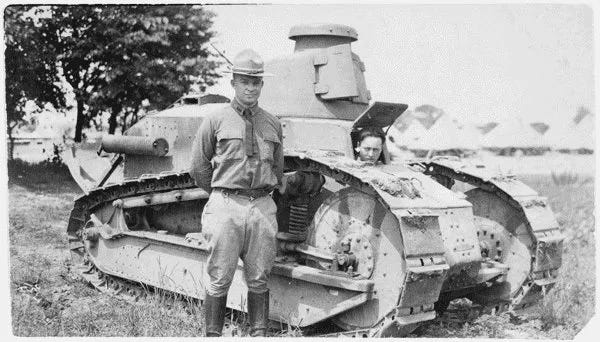
Eisenhower had first visited Gettysburg as a West Point cadet in 1915. He already had a deep interest in military history and Gettysburg captivated him, much like it had influenced my own story. In 1918, just three years after his graduation, the United States was gearing up to join the Allies in France for the First World War. As an infantry officer, Ike was itching to go and get his first taste of leading men into battle. The Army had other ideas, however, and assigned Eisenhower to command of a training center for the newly forming American tank corps. That training center would be housed on the Gettysburg Battlefield, which since 1895 had been under the control of the War Department as a site for training officers. With the need to train troops quickly to go “over there,” the familiar battle grounds of Pickett’s Charge, the Angle, and the Peach Orchard were transformed into an Army camp that would house as many as 10,000 soldiers over the course of eight months. Eisenhower, then a captain, would have a command the size of which was normally tasked to a Brigadier General.
But Ike was unhappy. “My mood was black,” he wrote in his book At Ease: Stories I Tell to Friends. He believed this command would be the end of his career and that missing out on combat and the glory it offered would leave him far behind his peers. He pleaded with the War Department with repeated letters begging to be given a combat command, offering to take a reduction in rank to do so, but the Army kept him in charge of what would be known as Camp Colt, named for Samuel Colt, the firearms maker.
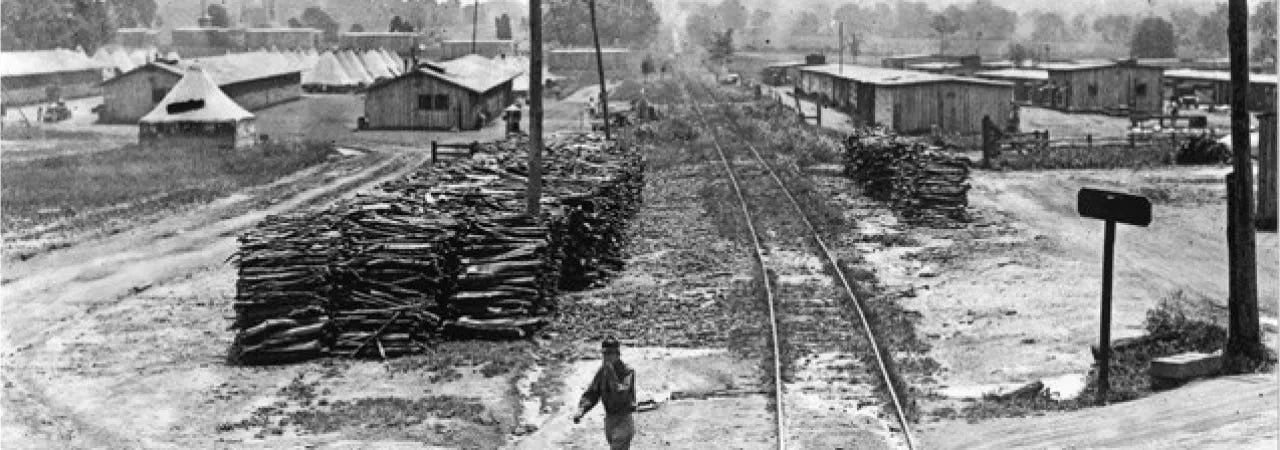
Eisenhower’s task was a tall one. He had to build the camp from scratch, insure that troops were properly housed and fed, and train them for the brand new implementation of tank warfare. Problem was that there was, by most accounts, only one working tank to train with: a two-man French Renault with a max speed of 6 mph. Tank maneuvers had to be simulated with trucks mounted with machine guns or small cannons. Given the limited training equipment for tankers to use, Eisenhower decided on his own initiative to open up schools for mechanics to service vehicles and signalmen to provide vital communication, believing that these skills would be useful at the front.
In the midst of it all, the Spanish Flu pandemic hit and it led to some 175 deaths among the troops. It might have been more had Eisenhower not taken swift action to isolate and regulate contact with those infected. That was a stressor beyond the normal kinds of things a commander has to deal with when it comes to large bodies of troops—keeping them out of trouble with alcohol and the normal diseases associated with camp followers. Eisenhower established a good rapport with the local Gettysburg community and developed his negotiating skills to maintain peace among the citizens and military personnel. All the while, Eisenhower kept nagging the War Department for a combat assignment until he was finally ordered to stop the letters!
The result of Eisenhower’s work was that some 9,000 troops were trained for combat in Europe, and it was remarkable that all who were mustered for embarkation were physically healthy, well-trained, and without a single AWOL (Absent Without Leave) among them. His work at Camp Colt was an outstanding achievement that would earn him a Distinguished Service Medal. The camp motto was “Treat ‘Em Rough,” ostensibly referring to the tanks or to the enemy. Eisenhower believed he had been treated rough himself, but he turned that roughness into valuable experience.
Had Eisenhower gone to Europe as he wanted, he would have been in command of 150 troops and there was a good chance he may not have made it back. He would never directly command troops in combat, but his experience at Camp Colt, his logistical and organizational mind, his ability to work with diverse groups of people toward a common goal, would be instrumental in him being chosen as the Supreme Allied Commander in Europe during World War II and, eventually, President of the United States. All of that was formed on those fields in Gettysburg.
I spent last Saturday walking the fields of Pickett’s Charge/Camp Colt on a Ranger-guided tour, envisioning the immense efforts and events that took place there just 55 years apart. All I could think of as I reflected on the Eisenhower story was an adage I heard from a seasoned pastor early in my ministry. He simply told me, “Bloom where you are planted.” Wherever you find yourself, even if it seems like work that’s beneath what you’d hoped for, give it your best. It’s akin to something that Jesus himself said: “If you are faithful in little things, you will be faithful in large ones” (Luke 16:10).
I wish I had been wise enough to take that advice during my internship. I might have benefitted from Ike’s example much earlier in my career as a leader. But I have since found it to be true—no place, no job, no task is too insignificant to give it your best.
Camp Colt was quickly dismantled at the end of World War I. The only remaining remnant is a pine tree planted in 1954 along the Emmitsburg Road by veterans of the training center. Eisenhower’s Farm is not far away, and now it’s a place I love to visit. Ike used those fields to learn what it means to be a leader, and they’re still teaching me today.
For further reading:
Sobun, Cheryl. “Eisenhower’s 1918 command of Gettysburg’s Camp Colt.” Celebrate Gettysburg website, October 29, 2016.
Tracey, John. “Spanish Influenza and Eisenhower’s Leadership at Gettysburg.” American Battlefield Trust website. September 21, 2021.
This Week’s Podcast
What really happened at Pentecost—and why does it still matter today? In this episode, we dive into Acts 2 and unpack Peter the Apostle’s bold, Spirit-filled sermon—the first proclamation of the risen Christ after the ascension. What transformed Peter from a fearful denier into a fearless preacher? The answer: the power of the Holy Spirit.
This conversation explores how Pentecost isn’t just a personal spiritual experience, but the launch of God’s renewed people—His presence no longer in a temple, but dwelling within the Church. By connecting the message of Book of Joel, the promises to King David, and the resurrection of Jesus, we see how God’s plan comes together in a powerful, world-changing moment.
If Jesus is truly Lord, everything changes. This episode challenges you to rethink faith, mission, and the Spirit’s work today.
This Week in Worship (3.10.26)

In the wake of the Holy Spirit coming on the followers of Jesus gathered on Pentecost, a new community is formed that will be called "the church." The word in Greek simply means "gathering," but the church gathers for a specific purpose and with specific practices--practices that we still engage in today as we gather. Teaching, fellowship, sacraments, prayer, and generosity are all essential parts of what it means to be the church, and all point us toward life in the new creation, the kingdom of God. Our worship includes all of these elements and knowing how they work together can help us see the church as a Kingdom movement more than an institution. Join us this Sunday as Pastor Bob Kaylor walks us through Acts 2:42-47 and looks at what it means for the church to be a Kingdom community under the lordship of Christ.
Really enjoyed reading this article. Very interesting! Love the saying, Bloom where you are planted. Such good advice! I added that one to my notes I keep on quotes I love.